The good in it
What tradition holds, and what research has found.
Bulukutu was a tradition long before it was studied. Laboratories have only begun to look closely, so we set out what they have found and link every source, so that you can read it for yourself.
Bulukutu is a herbal tea, not a medicine. Most of this research was done in laboratories and in animals rather than in people, so it describes the plant rather than promising an effect. If you are pregnant, breastfeeding or taking medication, please ask your doctor before drinking herbal tea every day.
Animal study
A calmer end to the day
With no caffeine in it, Bulukutu suits the evening. In a 1998 laboratory study in Brazzaville, an infusion of the dried leaves had a calming, sedative effect in rats.
Abena and colleagues, Université Marien Ngouabi, L’Encéphale, 1998 · Read the study
Laboratory analysis
Antioxidant compounds in the cup
Researchers at Stellenbosch University found that the brewed tea carries verbascoside and related compounds, antioxidants that made up as much as 15 percent of what dissolved from the leaves. A 2025 study in Bloemfontein also identified catechin and quercitrin in the plant.
Arthur and colleagues, Stellenbosch University, Food Chemistry, 2011 · Read the study
Tlhapi and colleagues, Central University of Technology, Molecules, 2025 · Read the study
The plant
Naturally caffeine-free
Lippia multiflora contains no caffeine, so you can drink it late at night as easily as first thing in the morning.
On the label
One plant, nothing added
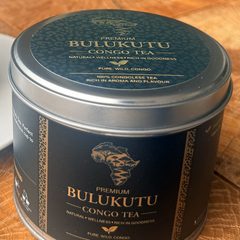
The tin holds Bulukutu leaf and stem and nothing else: no flavouring, no sweetener and no blend.
Tradition
A plant that healers trust
Traditional healers in the Congo use Bulukutu on its own or with other herbs, and laboratory research has begun to follow their lead.
Slow Food Foundation, Ark of Taste · Read the entry
Next